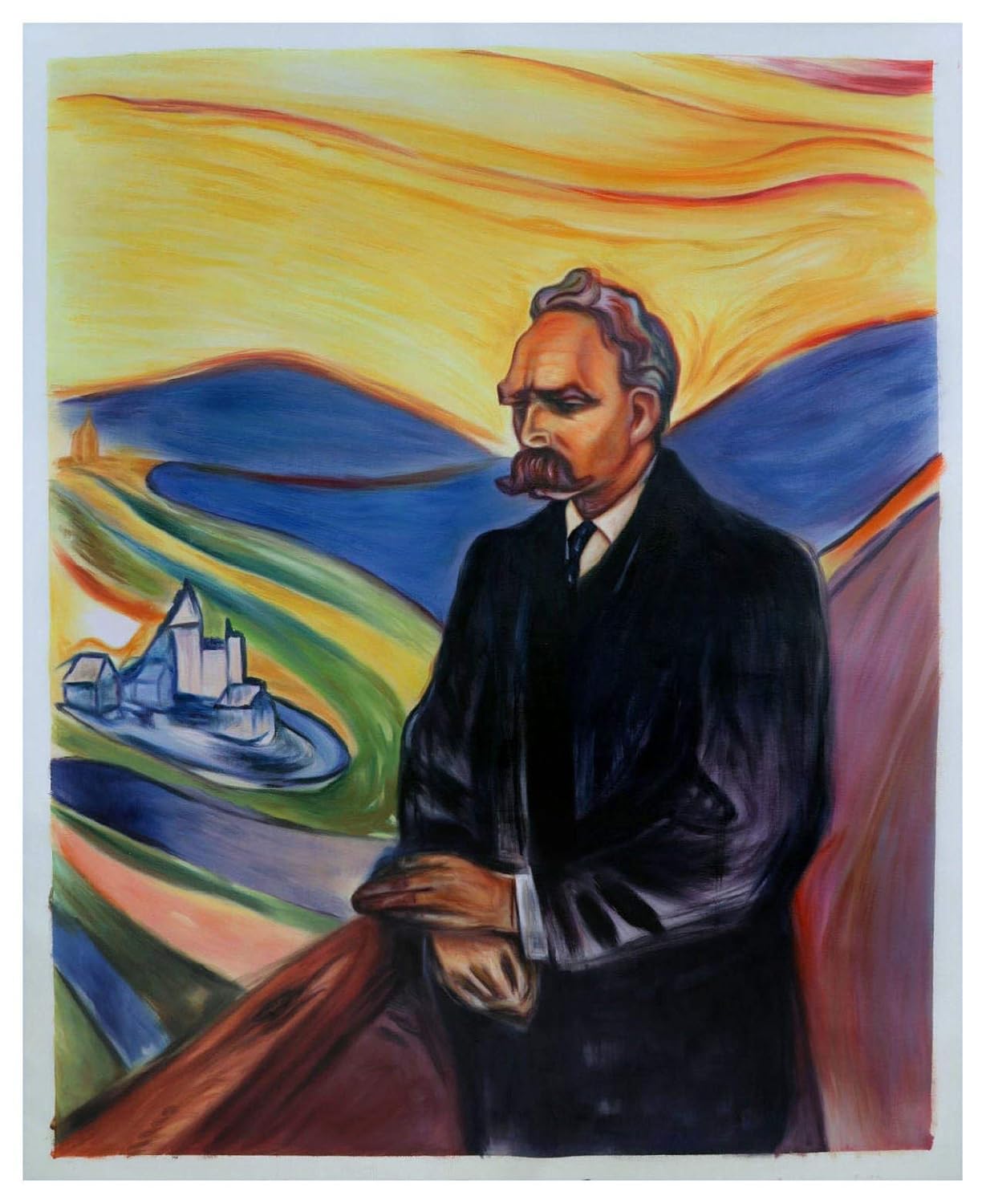
To me, the knowledge that can be gained from Nietzsche’s ideas comes mostly from where his contradictions of himself lie. A huge piece of these contradictions are brought forth from his standing as either a nihilist or anti-nihilist. This is not a contradiction that only lies within his Nietzsche’s created parameters, I believe these to be some of the inescapable contradictions of reality and those which forever allow us room to cry foul with regards to any set of guidelines. This may be demonstrated through his description of the Apollonian and Dionysian dichotomy and what I view as it’s impossible application. In The Birth of Tragedy, Nietzsche touches on his description of these lifestyles saying, “Thus far we have considered the Apollonian and its antithesis, the Dionysian, as artistic energies which burst forth from nature herself, without the mediation of the human artist; energies in which nature’s art impulses are satisfied in the most immediate and direct way: first, on the one hand, in the pictorial world of dreams, whose completeness is not dependent upon the intellectual attitude or the artistic culture of any single being; and, on the other hand, as drunken reality, which likewise does not heed the single unit, but even seeks to destroy the individual and redeem him by a mystic feeling of Oneness.” Here, Nietzsche defines the Apollonian ideology as a cerebral experience, one of a dream like existence, whereas the Dionysian life is a drunken reality where the individual is only a part of the whole. Now, I’m not disputing Nietzsche’s stance on this directly but rather using these constraints as a method of exemplifying the contradictions in our reality. For instance, if we urge a society towards a chaotic system, this remains a type of order and could be said to fall under the Apollonian perspective, continuing in this loop forever. In the same way, our life is filled with these inconsistencies to which there is no end. Here is why I believe Nietzsche has such trouble with self-conflict, life is contradiction on a universal and individual level. I also believe that this is an integral part of the absurd that Camus uses in his writings.
In Human, All Too Human, Nietzsche says,”At first single actions are termed good or bad without any reference to their motive, but solely because of the utilitarian or prejudicial consequences they have for the community. In time, however, the origin of these designations is forgotten [but] it is imagined[75] that action in itself, without reference to its consequences, contains the property “good” or “bad”: with the same error according to which language designates the stone itself as hard[ness] the tree itself as green[ness]—for the reason, therefore, that what is a consequence is comprehended as a cause.” I love this quote for how it shows our attachment to language and it’s communication of what we have forgotten. Aside from the contradictions mentioned previously, language also cannot preach to the experience, regardless of how many words we use. We have lost our connection to meaning, compared to times preceded when good or bad could be quantified by the actual disadvantages yielded by behavior. Today, the systems we are a part of are impossible to pay attention to, thus leaving the question of the value of our actions unanswerable. This is what I think has led us to our incessant need as a culture to deconstruct concepts and moral stances. You could also make the point that even if we could monitor the impact of our actions in this lifetime, we cannot beyond our death, making the implementation of consequentialism at any stage pointless. This is all to say that it is beyond even language to attempt to explain nihilism or anti-nihilism and that Nietzsche may be both at once when the border is impossible to define.
638 words
 flaccidmoney.finance.blog